

Articles
HCC Fashion Design student makes program history with 3D-fabricated garment
Mar 20, 2026
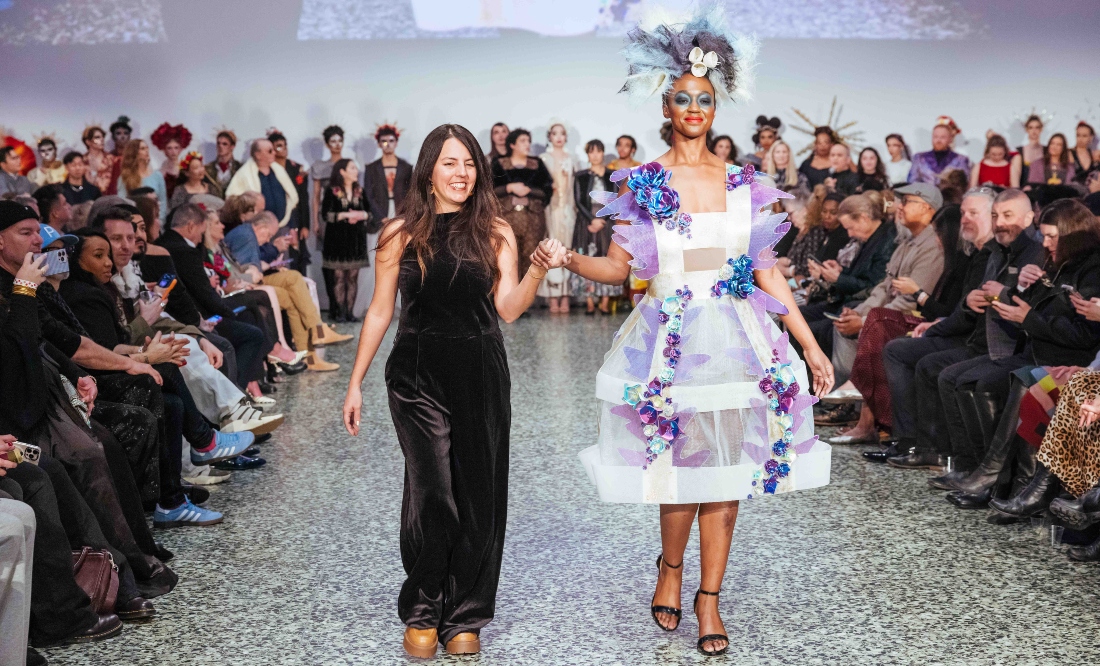
When Marisabel Morales sent her model down the runway at the 10th annual Fashion Fusion competition at the Museum of Fine Arts, Houston, she made history.
Morales, a student in Houston City College’s (HCC) award-winning Fashion Design program, became the first student to construct a fully 3D-printed gown––and the only designer at “Fashion Fusion X” to present a garment created entirely through 3D printing. The show on Jan. 30 paid tribute to the legendary artist Frida Kahlo.
Her piece, “Resilience in Bloom,” was created using the advanced fabrication tools in the Reality COLLAB at the HCC Central campus. The design reimagines fashion through additive manufacturing, sustainability and storytelling.
“This is the first time a student in the fashion design program has created a 3D garment,” said Cheryl Whitaker, fashion merchandising instructor. “I am always excited to see students push the envelope. Marisabel is exactly what the industry is looking for––someone who is creative and willing to explore new possibilities.”
Where Technology and Fashion Converge
Morales’ path to fashion was anything but conventional. Originally from Venezuela, she earned her first associate degree at HCC in cybersecurity. While studying computer science, she became deeply involved in the Reality COLLAB—first as a volunteer, then as a lab aide and now one as an eXtended Reality (XR) developer.
Founded in 2016, the Reality COLLAB is the first immersive technology lab of its kind at an educational institution in Texas. The lab integrates XR, Virtual Reality, 3D fabrication, immersive environments and digital design tools across disciplines.
“Marisabel is both a creative and a developer,” said Rubén Durán, Reality COLLAB co-founder. “She can work on almost any project. What makes this garment special is that she’s finding a place at HCC where that innovation can be nurtured. What she’s doing here can be taken to a national level.”
Inspired by designer Iris Van Herpen and Frida Kahlo’s “The Broken Column,” Morales approached her design through digital modeling and structural engineering, rather than traditional textiles.
She began using fashion design software, CLO3D, building the garment virtually based on model measurements provided by Fashion Fusion X organizers. She then refined the geometry in Blender, a 3D computer graphics software, before translating the design into printable components.
Because the printers’ build volume is limited to roughly two feet, Morales engineered the dress in modular segments. Each piece was measured, scaled, printed and manually assembled. The printing process alone took about 200 hours.
“She was so dedicated that she asked to check out the 3D printer during our Thanksgiving holiday,” said Lynden Marshall, Reality COLLAB co-founder. “That entire week, she worked on that dress.”
The garment was fabricated using recycled TPU (thermoplastic polyurethane) and PLA (polylactic acid), flexible filaments that allowed Morales to create mesh-like textures, iridescent floral elements and structural components that were thin enough to move with the body while remaining durable.
Sustainability by Design
While sustainability in fashion often focuses on repurposing existing garments, Morales approached the concept from a manufacturing perspective.
“With real fabric, you generate a lot of waste,” she explained. “In 3D printing, you design exactly what you need and print only that.”
Additive manufacturing reduces excess material because the garment is built layer by layer, rather than cut from larger textiles.
“I think she is the future of fashion,” Whitaker shared. “She’s merging technology and traditional methods. She’s developing her aesthetic and her voice, and that combination is powerful.”
With her sights set on graduating in 2027 with her Associate of Applied Science in Fashion Design, Morales’ long-term goal is clear: combine technology, sustainability and storytelling into a distinctive fashion career.
For HCC, Morales’ achievement signals more than a single innovative garment.
“This project demonstrates how students at HCC are not only learning traditional techniques but also pushing into emerging technologies that are shaping the future of fashion and wearable innovation,” Morales said.
Learn more about the HCC Fashion Design program at hccs.edu/fashiondesign.