
Electronics Engineering Technology
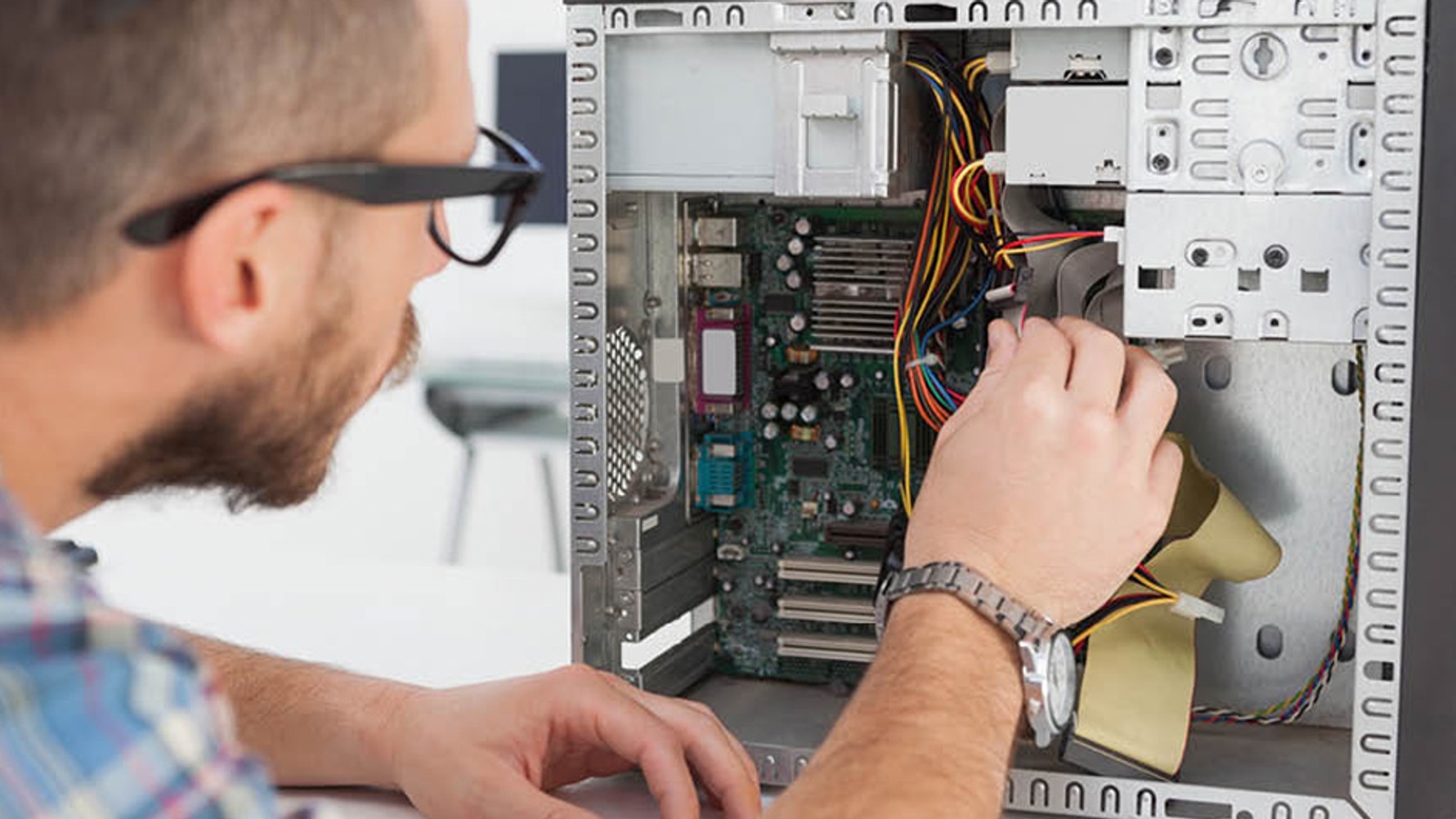
The Electronics Engineering Technology (EET) program prepares students to work with electronic circuits, computer hardware, networking systems, embedded devices, and biomedical equipment. Through classroom instruction, laboratory experiments, technical projects, and troubleshooting activities, students learn how to design, assemble, test, maintain, and repair electronic systems.
The program offers one Associate of Applied Science (AAS) degree with two specializations, along with two certificate programs.
- Career Path
- Science, Technology, Engineering & Math
Programs
Electronics Engineering Technology, Biomedical Elect. - Specialization, A.A.S.
The Biomedical Technology field has a growing need for technicians trained to maintain, troubleshoot, and repair medical equipment for health care facilities or research institutions. The Biomedical Electronics specialization includes a one-semester internship in a medical center, hospital, or medical equipment manufacturer, ensuring exposure to the latest equipment.
Graduates of this program may secure entry-level employment in positions such as electronics technician, field service representative, technical writer, sales representative, computer technician and network technician.
Areas of employment may include research and development, servicing and maintenance, manufacturing and sales. Job responsibilities may require technicians to install and test newly designed equipment, operate and maintain complex electronic systems, write servicing or operating manuals, as well as represent manufacturers and wholesale/retail establishments.
The AAS in Electronics Engineering Technology is accredited by Engineering Technology Accreditation Commission of ABET, under the commission’s General Criteria and Program Criteria for Electrical/Electronic(s) Engineering Technology and Similarly Named Programs.
All of the Electronics Engineering Technology AAS degrees are approved for Tech Prep. Qualified high school students may earn up to six credit hours toward the AAS degree through Tech Prep or dual credit. See an HCC counselor for information.
Students may transfer credits for the following courses to an Engineering Technology program at a four-year university in Texas: CETT 1403, DC Circuits; CETT 1405, AC Circuits; CETT 1425, Digital Fundamentals; CETT 1429, Solid State Devices; CETT 1357 (formally 1457), Solid State Circuits.
In addition, please note that a student may only earn one Occupational Skills Award (OSA) per academic year.
TSI testing required prior to first enrollment for all AAS degrees and Level II certificates.
The AAS in Electronics Engineering Technology is accredited by Engineering Technology Accreditation Commission of ABET, under the commission’s General Criteria and Program Criteria for Electrical/Electronic(s) Engineering Technology and Similarly Named Programs.
What is ABET?
ABET is a global quality assurance organization that accredits academic programs, recognizes credentials, and evaluates student learning to ensure educational programs meet high standards, preparing graduates with the skills required for the global workforce. ABET accreditation assures students, employers, and communities that accredited programs meet educational standards designed to prepare graduates with the knowledge and skills needed for the global workforce.
For EET students, ABET accreditation demonstrates that the program has been evaluated against recognized engineering technology education standards and is committed to preparing graduates with relevant technical knowledge and professional skills.
Upon graduation, students will have achieved the following outcomes in support of ABET accreditation.
- An ability to apply knowledge, technique, skills, and modern tools of mathematics, science, engineering, and technology to solve well-defined engineering problems appropriate to the discipline;
- An ability to design solutions for well-defined technical problems and assist with the engineering design of systems, components, or processes appropriate to the discipline;
- An ability to apply written, oral, and graphical communication in well-defined technical and non-technical environments; and an ability to identify and use appropriate technical literature
- An ability to conduct standard tests, measurements, and experiments and to analyze and interpret the results; and
- An ability to function effectively as a member of a technical team.
Have Questions?
We are here to help.
Electronics Engineering Technology
- Duration
- 2 years (full time)
- Program Format
-
- In-Person
- Campus Location
- Total Minimum Credits: 60
-
View the Electronics Engineering Technology, Biomedical Electronics - Specialization, A.A.S. degree plan to see the total credit hours required.
- Cost
-
Enter the semester credit hours into the Tuition & Cost Calculator to estimate tuition.
Electronics Engineering Technology, Computer Engineering - Specialization, A.A.S.
Computer Engineering Technology is perhaps the most flexible of the specializations offered. In this program you learn practical skills needed for immediate employment as an electronics technician, or to continue to higher levels of education. The basic theory and skills learned allow the individual to grow in the ever changing field of electronics technology.
Graduates of this program may secure entry-level employment in positions such as electronics technician, field service representative, technical writer, sales representative, computer technician and network technician.
Areas of employment may include research and development, servicing and maintenance, manufacturing and sales. Job responsibilities may require technicians to install and test newly designed equipment, operate and maintain complex electronic systems, write servicing or operating manuals, as well as represent manufacturers and wholesale/retail establishments.
The AAS in Electronics Engineering Technology is accredited by Engineering Technology Accreditation Commission of ABET, under the commission’s General Criteria and Program Criteria for Electrical/Electronic(s) Engineering Technology and Similarly Named Programs.
All of the Electronics Engineering Technology AAS degrees are approved for Tech Prep. Qualified high school students may earn up to six credit hours toward the AAS degree through Tech Prep or dual credit. See an HCC counselor for information.
Students may transfer credits for the following courses to an Engineering Technology program at a four-year university in Texas: CETT 1403, DC Circuits; CETT 1405, AC Circuits; CETT 1425, Digital Fundamentals; CETT 1429, Solid State Devices; CETT 1357 (formally 1457), Solid State Circuits.
In addition, please note that a student may only earn one Occupational Skills Award (OSA) per academic year.
TSI testing required prior to first enrollment for all AAS degrees and Level II certificates.
The AAS in Electronics Engineering Technology is accredited by Engineering Technology Accreditation Commission of ABET, under the commission’s General Criteria and Program Criteria for Electrical/Electronic(s) Engineering Technology and Similarly Named Programs.
What is ABET?
ABET is a global quality assurance organization that accredits academic programs, recognizes credentials, and evaluates student learning to ensure educational programs meet high standards, preparing graduates with the skills required for the global workforce. ABET accreditation assures students, employers, and communities that accredited programs meet educational standards designed to prepare graduates with the knowledge and skills needed for the global workforce.
For EET students, ABET accreditation demonstrates that the program has been evaluated against recognized engineering technology education standards and is committed to preparing graduates with relevant technical knowledge and professional skills.
Upon graduation, students will have achieved the following outcomes in support of ABET accreditation.
- An ability to apply knowledge, technique, skills, and modern tools of mathematics, science, engineering, and technology to solve well-defined engineering problems appropriate to the discipline;
- An ability to design solutions for well-defined technical problems and assist with the engineering design of systems, components, or processes appropriate to the discipline;
- An ability to apply written, oral, and graphical communication in well-defined technical and non-technical environments; and an ability to identify and use appropriate technical literature
- An ability to conduct standard tests, measurements, and experiments and to analyze and interpret the results; and
- An ability to function effectively as a member of a technical team.
Have Questions?
We are here to help.
Electronics Engineering Technology
- Duration
- 2 years (full time)
- Program Format
-
- In-Person
- Campus Location
- Total Minimum Credits: 60
-
View the Electronics Engineering Technology, Computer Engineering - Specialization, A.A.S. degree plan to see the total credit hours required.
- Cost
-
Enter the semester credit hours into the Tuition & Cost Calculator to estimate tuition.
Electronics Engineering Technology, Computer Servicing / Networks, C1
Computer Engineering Technology is perhaps the most flexible of the specializations offered. In this program you learn practical skills needed for immediate employment as an electronics technician, or to continue to higher levels of education. The basic theory and skills learned allow the individual to grow in the ever changing field of electronics technology.
Graduates of this program may secure entry-level employment in positions such as electronics technician, field service representative, technical writer, sales representative, computer technician and network technician.
Areas of employment may include research and development, servicing and maintenance, manufacturing and sales. Job responsibilities may require technicians to install and test newly designed equipment, operate and maintain complex electronic systems, write servicing or operating manuals, as well as represent manufacturers and wholesale/retail establishments.
Students may transfer credits for the following courses to an Engineering Technology program at a four-year university in Texas: CETT 1403, DC Circuits; CETT 1405, AC Circuits; CETT 1425, Digital Fundamentals; CETT 1429, Solid State Devices; CETT 1357 (formally 1457), Solid State Circuits.
In addition, please note that a student may only earn one Occupational Skills Award (OSA) per academic year.
Have Questions?
We are here to help.
Electronics Engineering Technology
- Duration
- 3 semesters (full time)
- Program Format
-
- In-Person
- Campus Location
- Total Minimum Credits: 17
-
View the Electronics Engineering Technology, Computer Servicing / Networks, C1 degree plan to see the total credit hours required.
- Cost
-
Enter the semester credit hours into the Tuition & Cost Calculator to estimate tuition.
Electronics Engineering Technology, Basic Electronics, C2
Computer Engineering Technology is perhaps the most flexible of the specializations offered. In this program you learn practical skills needed for immediate employment as an electronics technician, or to continue to higher levels of education. The basic theory and skills learned allow the individual to grow in the ever changing field of electronics technology.
Graduates of this program may secure entry-level employment in positions such as electronics technician, field service representative, technical writer, sales representative, computer technician and network technician.
Areas of employment may include research and development, servicing and maintenance, manufacturing and sales. Job responsibilities may require technicians to install and test newly designed equipment, operate and maintain complex electronic systems, write servicing or operating manuals, as well as represent manufacturers and wholesale/retail establishments.
Students may transfer credits for the following courses to an Engineering Technology program at a four-year university in Texas: CETT 1403, DC Circuits; CETT 1405, AC Circuits; CETT 1425, Digital Fundamentals; CETT 1429, Solid State Devices; CETT 1357 (formally 1457), Solid State Circuits.
In addition, please note that a student may only earn one Occupational Skills Award (OSA) per academic year.
TSI testing required prior to first enrollment for all AAS degrees and Level II certificates.
Have Questions?
We are here to help.
Electronics Engineering Technology
- Duration
- 3 semesters (full time)
- Program Format
-
- In-Person
- Campus Location
- Total Minimum Credits: 43
-
View the Electronics Engineering Technology, Basic Electronics, C2 degree plan to see the total credit hours required.
- Cost
-
Enter the semester credit hours into the Tuition & Cost Calculator to estimate tuition.
Program Mission
The mission of the Electronic Engineering Technology Department is to provide educational and training opportunities to individuals so that they may achieve their highest potential for employment in the field of Electronics. This is accomplished by providing a curriculum in Electronics Engineering Technology consistent with the mission of the Houston City College System in cooperation with business and industry.
Career Outlook
This overview highlights key labor market indicators for University Transfer and Workforce Training careers in this field in the Houston area, including the number of currently employed, the median annual salary for the occupation, and the job growth.
Average Salary
50th percentile (median) salary range in the Houston area.
Currently Employed
4,920 currently employed in the Greater Houston area.
Projected Growth
4.5% projected growth for 2026-2030.
Internship and Practical Training Opportunities
The EET program encourages students to gain practical workplace experience through internships, supervised technical training, and industry-related projects.
Electronics Engineering Technology Internship — Courses
The Electronics Engineering Technology specializations include, internships course designed to provide supervised workplace experience in a relevant technical environment.
Students coordinate internship arrangements with an appropriate organization and obtain departmental approval. Placement opportunities depend on employer availability and applicable course requirements.
Possible internship areas
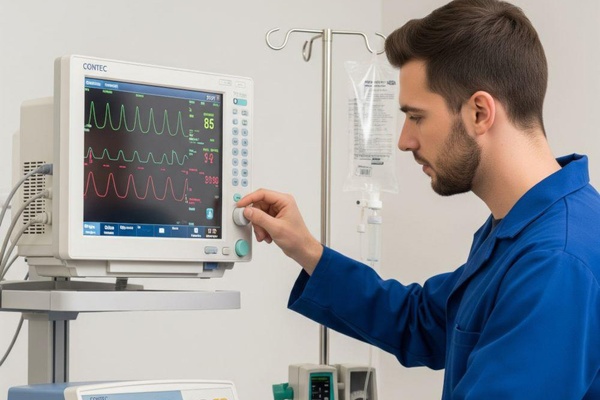
Biomedical Equipment and Clinical Engineering
Experience with medical equipment inspection, preventive maintenance, calibration, testing, troubleshooting, and technical documentation in healthcare environments.
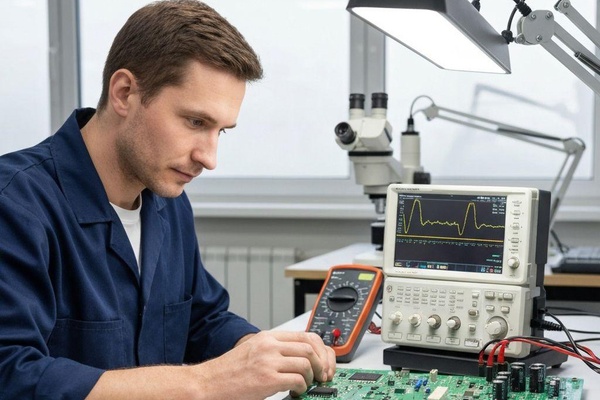
Electronics Testing and Manufacturing
Practical experience in electronic circuit assembly, testing, measurements, product inspection, quality control, and troubleshooting.

Computer Hardware and Networking
Experience with computer installation, hardware diagnostics, network configuration, maintenance, and technical support.
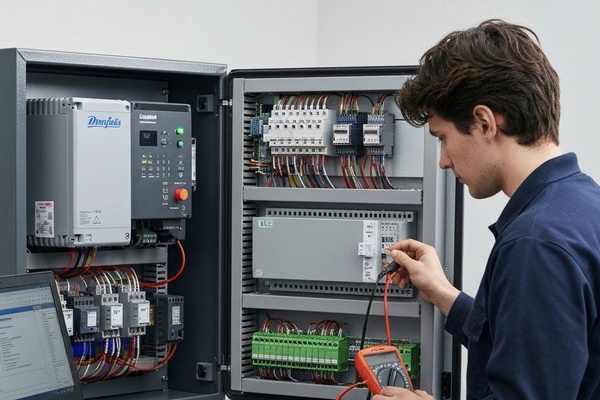
Industrial Electronics and Automation
Practical exposure to electronic control systems, industrial instrumentation, sensors, automation equipment, and technical maintenance.
Potential Job Titles for EET Graduates
EET graduates may pursue entry-level technical positions in electronics, computer technology, biomedical equipment maintenance, and related fields.
Please Note:
Job qualifications vary by employer. Some positions may require additional training, professional certifications, or work experience.
- Electronics Engineering Technician
- Electronics Installers and Repairers
- Electronics Test Technician
- Electronic Assembly Technician
- Instrumentation Technician
- Field Service Technician
- Automation and Robotics Technicians
- Telecommunications Technicians
- Industrial Maintenance Technicians
- Test and Calibration Technicians
- Technical Sales Representatives
- Electronic or Industrial Equipment
- Computer Hardware Technician
- Computer Support Technician
- Network Support Technician
- Computer Repair Technician
- Systems Support Technician
- Technical Support Specialist
- Biomedical Equipment Technician
- Medical Equipment Repair Technician
- Clinical Engineering Technician
- Healthcare Technology Support Technician
- Medical Device Field Service Technician
Explore Your Future in Technology
Houston City College's Electronics Engineering Technology program offers educational pathways in computer engineering technology, biomedical engineering technology, and basic electronics. For more information about degree specializations, certificates, course requirements, and enrollment, contact the EET program.